
When a tooth’s nerve is infected or dying, you usually have two real choices: save it with a root canal or remove it. Few decisions in dentistry carry more emotion, especially for people drawn to biological dentistry, where you’ll hear strong claims that root-canal-treated teeth are toxic. The question of root canal vs extraction deserves a calmer, evidence-based answer, tooth by tooth.
Endodontics and the “focal infection” debate were the subject of an entire module in my integrative training through the American College of Integrative Medicine and Dentistry (ACIMD), with lecturers on both sides of the question. Here’s where I’ve landed after weighing that material against the research.
Key takeaways
- The biggest risk isn’t the root canal itself. It’s a chronic infection at the root tip that goes untreated. A successful root canal and a well-done extraction both remove that infection.
- Teeth with apical periodontitis (infection at the root tip) are associated with higher rates of cardiovascular disease, but studies haven’t shown cause and effect.
- Most root-canal-treated teeth last: pooled studies find 86% to 93% still in place 2 to 10 years after treatment. When treatment succeeds, systemic inflammatory and metabolic markers may actually improve.
- Extraction is the better choice when a tooth is cracked through the root, can’t be restored, has lost too much bone, or has failed treatment more than once.
- In my biological root canals, I disinfect the canals with three tools: ultrasonic irrigation, an erbium laser, and ozone.
The Old Theory Behind the Fear
In the early 1900s, the “focal infection theory” held that infected teeth seeded disease throughout the body. Dentist Weston Price performed experiments suggesting root-canal-treated teeth caused illness, and large numbers of teeth were extracted in the hope of curing arthritis and other diseases. Later research found serious flaws in those methods, and the mass extractions didn’t cure the conditions they targeted. The American Association of Endodontists considers the theory debunked and states that there is no valid scientific evidence linking root canal treatment to disease elsewhere in the body.
The idea came back into popular circulation in the 1990s, and it’s still taught in some integrative settings. One lecture I attended argued that every root-canal-treated tooth remains chronically infected and is a leading cause of heart attacks. That’s a much stronger claim than the evidence supports.
What Modern Research Actually Shows
The more careful field of “endodontic medicine” asks a better question: does apical periodontitis, a chronic infection and inflammation at the root tip, affect the rest of the body?

- An association with heart disease exists. A 2025 umbrella review that pooled ten systematic reviews found that people with apical periodontitis had about 83% higher odds of cardiovascular disease. The same review noted high variability between studies, inconsistent definitions, and shared risk factors such as smoking and diabetes, and it found the evidence insufficient to establish that the dental infection causes heart disease.
- The relationship runs both ways. Conditions like diabetes can make root-tip infections more likely and slower to heal.
- Treating the infection may help the body. A 2025 study from King’s College London followed 65 patients for two years after root canal treatment. After successful treatment, blood glucose fell significantly and several markers linked to cardiovascular risk declined. It was a cohort study and can’t prove cause and effect, but it points in a direction that matters: removing a chronic infection is good for you, whether that happens through a root canal or an extraction.
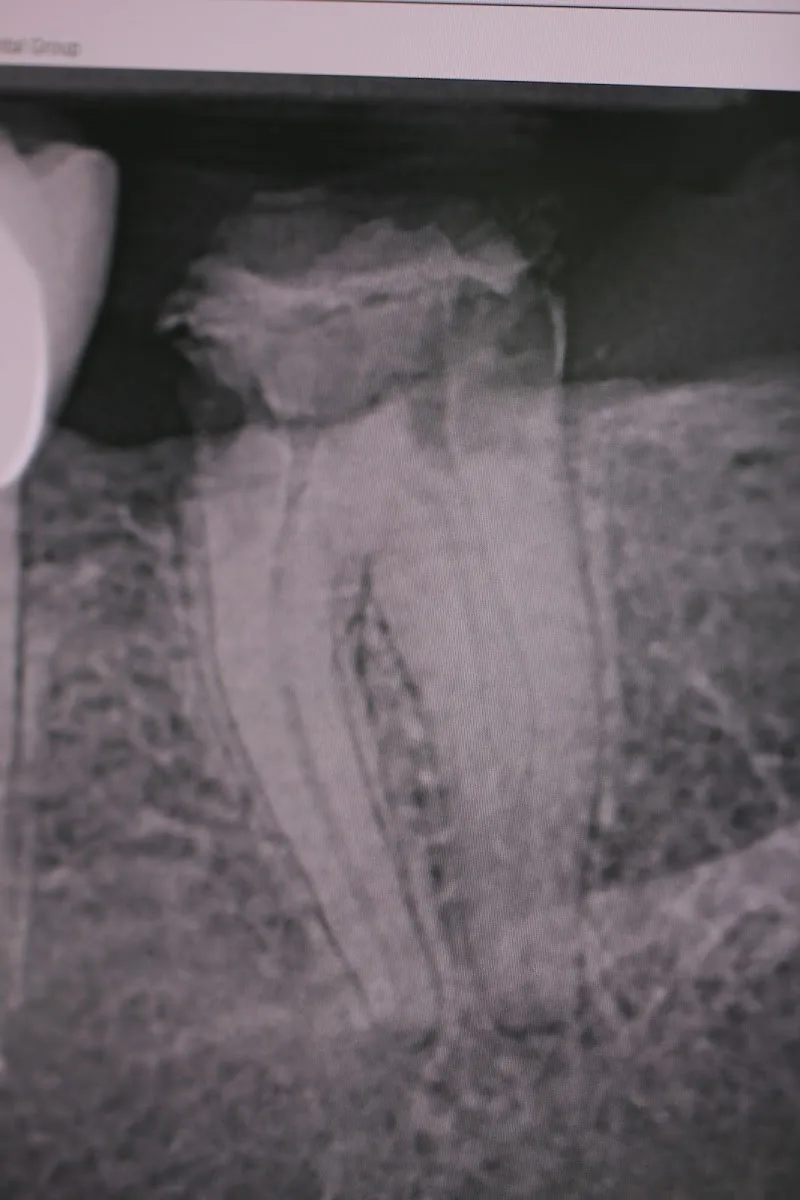
Here’s what treating that infection looks like inside a tooth. These before-and-after photos are from a root canal in my practice:


The practical conclusion I draw is simple. Untreated or failing infections deserve treatment. A healthy, successfully treated root canal tooth isn’t the problem biological dentistry once feared.
Root Canal vs Extraction: When Saving the Tooth Makes Sense
| Factor | Favors a root canal | Favors extraction |
|---|---|---|
| Remaining tooth structure | Enough to support a crown or onlay | Not restorable |
| Root condition | No vertical root fracture | Crack extending down the root |
| Gum and bone support | Healthy or treatable | Severe bone loss or mobility |
| Treatment history | First-time treatment or a retreatable failure | Repeated failures, or retreatment unlikely to succeed |
| Overall health | Normal healing | Individualize when healing is impaired |
| Your priorities | Keeping your natural tooth | Avoiding a root canal, with a clear replacement plan |

A natural tooth, even a root-canal-treated one, comes with its own ligament, which gives you subtle feedback when you bite and cushions chewing forces. Implants are excellent replacements, but they’re not maintenance-free. In a large Swedish study, about one in seven implant patients had moderate-to-severe peri-implantitis after nine years.
What a “Biological” Root Canal Looks Like
Not all root canals are done the same way. If you’re keeping a tooth, these are the elements I’d look for:

- Accurate diagnosis with 3D cone-beam imaging when the situation is unclear, since standard X-rays can miss root-tip infections
- Rubber dam isolation for every procedure
- Magnification, ideally a dental microscope, to find and clean all canals
- Thorough disinfection of the whole canal system with proven irrigants such as sodium hypochlorite; in my practice, that means ultrasonic irrigation, laser disinfection, and ozone, explained below
- Biocompatible filling materials, such as calcium-silicate (bioceramic) sealers; paraformaldehyde-containing pastes should be avoided, and the American Association of Endodontists recommends against them
- A prompt, well-sealed final restoration, because leakage from the top is a common cause of failure
- Follow-up imaging to confirm healing
How I disinfect the canals: ultrasonic irrigation, laser, and ozone
Files can shape the main canals, but a root canal system is a maze of branches, fins, and side channels that no instrument can fully reach, and bacteria also live inside the tiny tubules of the surrounding dentin. That’s why, in every biological root canal I do, I use three disinfection tools together:
- 1. Ultrasonic irrigation. After the canals are shaped and filled with a disinfecting solution (sodium hypochlorite), I place a thin ultrasonic tip in the canal. Its vibration creates strong microscopic currents that drive the solution into areas files can’t touch and flush out debris. Studies of this technique, called passive ultrasonic irrigation, show it removes more tissue, debris, and bacteria than rinsing with a syringe alone.
- 2. Laser disinfection. I then use an erbium dental laser with a fine, flexible tip that fits inside the canal. The laser energy activates the irrigating solution and can kill bacteria in the dentin walls around the canal, beyond the reach of the solution alone. Laboratory studies have shown large bacterial reductions with this type of laser tip. See holistic laser dentistry for more on how I use lasers.
- 3. Ozone. As a final step, I apply ozone in the canal as an extra antimicrobial. Ozone kills bacteria on contact and breaks down into oxygen, so it leaves no chemical residue. It’s an add-on, not a replacement: in lab studies, ozonated water killed bacteria in dentin about as well as sodium hypochlorite in one model, while ozone gas was less effective than sodium hypochlorite in another. See ozone therapy in dentistry.
Each tool attacks bacteria in a different way, and together they give the canal system the most thorough cleaning I can offer before it’s sealed with a biocompatible bioceramic material. To be clear about the evidence: most studies of these tools are laboratory or short-term studies, and no trial has yet shown that combining all three improves long-term success compared with standard care. I use them because they’re low-risk and each one adds disinfection where the others may fall short.
When Extraction Is the Right Call
If the tooth can’t be saved predictably, removing it is the healthy choice. A careful extraction includes gentle removal to preserve bone, thorough cleaning of the infected socket, and often platelet-rich fibrin or bone grafting depending on the replacement plan (see biological tooth extraction). Then plan the replacement before or at the time of extraction:

- An implant, titanium or zirconia, usually the closest thing to a natural tooth (see how to prepare for dental implant surgery)
- A bridge attached to neighboring teeth
- A removable partial denture
- No replacement, which can be reasonable for some back molars but can let neighboring teeth drift
Questions to Ask Your Dentist
- What’s causing the problem, and how sure are we? Would a 3D scan change the plan?
- What are the realistic odds of success for a root canal on this particular tooth?
- If we save it, what restoration will it need, and when?
- If we remove it, what will replace it, what will that cost, and how long will it take?
- What happens if I wait?
Frequently Asked Questions
Are root canals safe?
For most people, yes. In pooled studies, roughly 86% to 93% of root-canal-treated teeth are still functioning 2 to 10 years later, and treatment removes the infection inside the tooth. Large studies haven’t shown that successfully treated root canal teeth cause systemic disease, while untreated root-tip infections are associated with health risks.
Is it better to get a root canal or pull the tooth?
It depends on the tooth. If it’s restorable, has good bone support, and has no root fracture, a root canal usually preserves a strong natural tooth. If it’s cracked through the root, badly broken down, or has failed treatment repeatedly, extraction with a planned replacement is often the better choice.
Do root canals cause heart disease or cancer?
There’s no good evidence that a successful root canal causes heart disease or cancer. Chronic infection at the root tip, called apical periodontitis, is associated with heart disease, but a causal link hasn’t been established. Treating that infection, by root canal or extraction, is what matters.
What is a biological root canal?
It’s a root canal done with extra attention to disinfection and materials: careful diagnosis, rubber dam isolation, magnification, thorough irrigation sometimes activated by lasers or ultrasonics, biocompatible bioceramic sealers, no paraformaldehyde pastes, and a well-sealed restoration afterward.
How do I know if my root canal has failed?
Warning signs include pain when biting, swelling, a pimple-like bump on the gum, or tenderness near the tooth. Some failures cause no symptoms and show up only on X-rays or a 3D scan. Regular checkups with imaging help catch problems early.
How do you disinfect the canals during a biological root canal?
In my practice, I use three tools together. Ultrasonic irrigation vibrates the disinfecting solution (sodium hypochlorite) so it reaches side channels files can’t; an erbium laser with a thin tip activates the solution and kills bacteria in the canal walls; and ozone is applied as a final antimicrobial step. Each is an addition to careful cleaning and shaping, not a replacement for it.
Bottom Line
The choice between a root canal and an extraction shouldn’t be driven by fear of a century-old theory or by a blanket rule. Chronic infection is the real problem, and both treatments can remove it. Save teeth that can be saved predictably with careful, biologically minded technique, and remove teeth that can’t, with a thoughtful plan for what comes next.
References
- American Association of Endodontists. The focal infection theory.
- Talekar AW, et al. Association between cardiovascular diseases and apical periodontitis: an umbrella review with stratification of evidence and sensitivity analysis. Journal of Dentistry. 2025;161:105943.
- Niazi S, et al. Two-year cohort study of serum metabolic changes after root canal treatment (65 patients). Journal of Translational Medicine. November 2025. Summary: Oral Health Group.
- Cintra LTA, et al. Evolution of endodontic medicine: a critical narrative review of the interrelationship between endodontics and systemic pathological conditions. Odontology. 2021;109:741-769.
- Jiménez Sánchez MC, et al. Cardiovascular diseases and apical periodontitis: association not always implies causality. Medicina Oral, Patología Oral y Cirugía Bucal. 2020;25(5).
- Derks J, et al. Effectiveness of implant therapy analyzed in a Swedish population: prevalence of peri-implantitis. Journal of Dental Research. 2016;95(1):43-49.
- Ng YL, Mann V, Gulabivala K. Tooth survival following non-surgical root canal treatment: a systematic review of the literature. International Endodontic Journal. 2010.
- Ng YL, Mann V, Gulabivala K. A prospective study of the factors affecting outcomes of non-surgical root canal treatment: part 2: tooth survival. International Endodontic Journal. 2011;44(7):610-625.
- Karabucak B, Bunes A, Chehoud C, Kohli MR, Setzer F. Prevalence of apical periodontitis in endodontically treated premolars and molars with untreated canal: a cone-beam computed tomography study. Journal of Endodontics. 2016;42(4):538-541.
- van der Sluis LWM, Versluis M, Wu MK, Wesselink PR. Passive ultrasonic irrigation of the root canal: a review of the literature. International Endodontic Journal. 2007;40(6):415-426.
- Gordon W, et al. The antimicrobial efficacy of the erbium, chromium:yttrium-scandium-gallium-garnet laser with radial emitting tips on root canal dentin walls infected with Enterococcus faecalis. Journal of the American Dental Association. 2007;138(7):992-1002.
- Nagayoshi M, et al. Antimicrobial effect of ozonated water on bacteria invading dentinal tubules. Journal of Endodontics. 2004;30(11):778-781.
- Hems RS, Gulabivala K, Ng YL, Ready D, Spratt DA. An in vitro evaluation of the ability of ozone to kill a strain of Enterococcus faecalis. International Endodontic Journal. 2005;38(1):22-29.
About the Author

Dr. Gyu Hwang, DDS, practices at Evergreen Dental Wellness in Annandale, Virginia. He has treated patients since 2004, beginning with his clinical training at the University of Michigan School of Dentistry (DDS, 2006). His postgraduate training includes the Pankey Institute, the Dawson Academy, the Kois Center, and biological and integrative dentistry through the American College of Integrative Medicine and Dentistry (ACIMD). His practice focuses on biological dentistry, implants, laser dentistry, and sleep appliances. Read more about Dr. Hwang.
This article is for education and does not replace an in-person dental evaluation.