
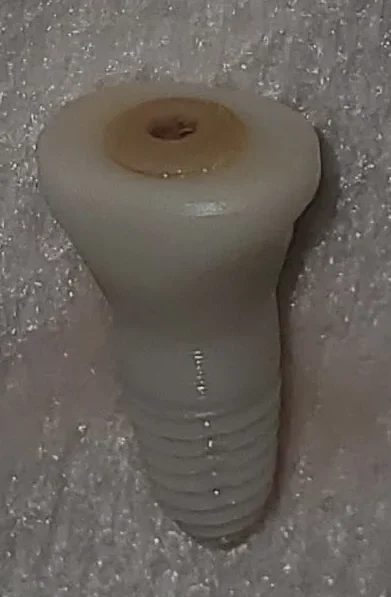
Ceramic dental implants, almost always made of zirconia, are the metal-free alternative to titanium implants. They’re one of the most asked-about options in biological dentistry, and also one of the most oversold. Some websites present them as the only safe choice, while others dismiss them as a fad. The truth sits in between.
My restorative training at the Pankey Institute, the Dawson Academy, and the Kois Center and my biological dentistry training through the American College of Integrative Medicine and Dentistry (ACIMD) both shape how I approach implants. Below is what the research actually shows, who I think ceramic implants suit, and where they fall short, followed by an immediate implant case from my practice, shown from healing to the final crown.
Key takeaways
- Ceramic implants are made of zirconia (zirconium dioxide), a strong, tooth-colored ceramic that contains no titanium.
- A 2023 review of 25 studies and 4,017 zirconia implants estimated 95.1% survival at 10 years. Most failures happened in the first year.
- Titanium is still by far the most studied implant material, with decades of data and many more design options.
- True titanium allergy is rare (0.6% in a study of 1,500 implant patients), but some people prefer to avoid metal, and zirconia avoids gray show-through in thin gums.
- Ceramic implants have real trade-offs: less long-term data, fewer component options, and technique-sensitive placement. The dentist’s experience matters.
What Is a Ceramic Implant?
A ceramic implant is a screw-shaped post placed in the jawbone to replace a tooth root, just like a titanium implant. The difference is the material. Nearly all ceramic implants today are made of zirconia (zirconium dioxide), a white, very strong ceramic also used for crowns and bridges. Zirconia is technically a metal oxide, but it behaves like a ceramic: it’s highly resistant to corrosion, it doesn’t conduct electricity, and it contains no titanium.

One-piece vs. two-piece designs
One-piece ceramic implants have the implant and the abutment (the post the crown attaches to) made as a single unit. They’re strong and have no internal joint where bacteria can collect. The trade-off is that the top sticks out through the gum from day one, so it has to be protected from biting forces while it heals, and its angle can’t be corrected later.
Two-piece ceramic implants work more like titanium systems. The implant heals first, and a separate abutment is attached later, either bonded or held with a screw. That gives more flexibility for angles and for front teeth. In a 2025 review of two-piece zirconia implants, most abutment fractures occurred with bonded (glued) abutments, while the one screw-retained study reported no complications. That’s encouraging, but it’s based on a small number of implants.
An Immediate Ceramic Implant Case from My Practice
These photos are from my practice. It was an immediate case: an upper front tooth was removed, and a two-piece SDS (Swiss Dental Solutions) zirconia implant was placed in the same visit. With a two-piece design, the implant heals in the bone first, and the abutment and crown are attached afterward. The first photo was taken right after surgery, with the implant seated in the fresh socket. In the next two, the implant is healing and the gum is shaping around the white ceramic collar. The last photo shows the finished crown.


Two things stand out in a case like this. First, there’s no gray metal shadow at the gumline, which matters for front teeth when the gum is thin. Second, the gum tissue has healed closely around the collar, which helps create a natural-looking gumline once the crown is placed.
A result like this depends less on the implant material than on careful planning: 3D imaging, ideal implant position, enough bone and gum tissue, and a crown designed to match the neighboring teeth. Zirconia simply removes one esthetic risk. If you’re getting ready for treatment, see my guide on how to prepare for dental implant surgery.
What “immediate” means
An immediate implant is placed in the same visit the tooth is removed, instead of waiting several months for the socket to heal first. It combines the extraction and the implant placement into one surgery and can shorten overall treatment time. It isn’t right for every situation, though. The implant has to be held firmly by healthy bone from day one, and any infection at the site must be cleaned out and under control. How the tooth comes out matters too, and I explain my approach in my guide to biological tooth extraction.
Ceramic vs. Titanium Implants: Quick Comparison
| Feature | Ceramic (zirconia) | Titanium |
|---|---|---|
| Color | White, tooth-colored | Gray metal |
| Research base | Mostly short- to medium-term studies; some 10-year data | Decades of research and long-term data |
| Survival in studies | About 95% at 10 years in a 2023 review | The long-established benchmark |
| Design options | Fewer sizes, angles, and parts | Wide range, including angled and full-arch options |
| Metal sensitivity | Metal-free alternative | True allergy is rare (about 0.6% in one study) |
| Thin gums, front teeth | No gray show-through | Gray can show through thin gum |
| Angle correction | Limited, especially with one-piece designs | Easy with angled abutments |
| Cost | Usually higher | Usually lower |
| Gum disease around implants | Can still occur | Can occur |
What the Research Shows
The best recent summary is a 2023 systematic review and meta-analysis by Mohseni and colleagues in Clinical Oral Investigations. It pooled 25 studies covering 4,017 zirconia implants in 2,083 patients:
- About 4% of implants failed, mostly within the first year (average time to failure: 12 months).
- Estimated survival at 10 years was 95.1%.
- Bone loss around the implants was low in the short term.
- Two-piece implants failed more often than one-piece implants (7.5% vs. 4.1%), though far fewer two-piece implants were studied.
- Most implant fractures came from older, discontinued, narrow-diameter designs.
A 2025 systematic review focused on two-piece zirconia implants found a weighted survival rate of about 96% across six studies and 298 implants, with follow-up ranging from about 1 to 9 years. Gum inflammation around the implants (mucositis) and peri-implantitis did occur, and most abutment fractures happened with bonded abutments.
My honest read: modern zirconia implants perform well in the short to medium term, and their survival numbers are in the range people expect from implants. But the evidence base is a fraction of titanium’s, many studies are small and retrospective, and most lasted five years or less. The 2023 review’s authors call the results promising while noting that zirconia has been studied far less than titanium.
Is Titanium Really a Problem?
Titanium has an excellent safety record, and for most people it’s a great implant material. The concerns that bring patients to biological dentists usually fall into three groups:
- Allergy or sensitivity. In a study of 1,500 consecutive implant patients, Sicilia and colleagues found titanium allergy in 9 people (0.6%). It’s rare but real, and it was more likely in patients who had allergy-like reactions after implant surgery.
- Titanium particles. Researchers have found higher levels of dissolved titanium in plaque around implants with peri-implantitis. It isn’t clear whether the titanium helps cause the inflammation or is released because of it.
- Preference. Some patients simply want a metal-free mouth, often after having amalgam fillings removed. That’s a legitimate choice as long as it’s an informed one.
If you suspect a metal sensitivity, testing can help, but every test has limits. I compare patch tests, blood tests such as MELISA, and other methods in my guide to dental material biocompatibility testing.
Who Might Choose a Ceramic Implant?
Ceramic implants are worth a serious look if you:
- Have a confirmed or strongly suspected titanium sensitivity
- Want to avoid metal for personal or health reasons
- Need a front tooth replaced and have thin gum tissue, where gray metal could show
- Have had unexplained problems with metal dental work in the past
- Have good bone volume and healthy gums, or are willing to treat gum disease first
Titanium may be the better choice if you need several implants or a full-arch bridge, need sharply angled implants, or have bone so narrow that it would require a narrow-diameter implant. Heavy grinding raises the risk for any implant, so a night guard becomes essential either way.
Limitations and Trade-offs
- Less long-term data. Most studies follow patients for five years or less.
- Fewer options. There are fewer implant sizes, angled abutments, and prosthetic parts, so not every case fits.
- Technique sensitivity. Zirconia can’t be bent or adjusted the way titanium parts can. In the 2023 review, one-piece implants whose tops were reshaped with a drill failed more often (7.5% vs. 3.5%).
- Protection during healing. One-piece implants stick through the gum while healing and must be shielded from chewing forces.
- Cost. Ceramic implants and their parts usually cost more than titanium. See my zirconia implant cost breakdown for what a complete estimate includes.
- Not immune to gum disease. Peri-implantitis can still develop around zirconia, so home care and regular cleanings matter just as much.
Questions to Ask Before Choosing a Ceramic Implant
- Which implant system will you use, and is it FDA-cleared?
- Is it one-piece or two-piece, and why is that the right choice for my case?
- How many ceramic implants have you placed, and can I see examples?
- Will the crown be screwed or cemented on?
- Will you use 3D imaging (CBCT) to plan the implant position?
- What happens if the implant fails or fractures, and what would that cost?
Several zirconia implant systems have FDA 510(k) clearance in the US. For example, the SDS system I use has clearance for its one-piece SDS1.2 implant (2019) and its two-piece SDS2.2 implant (2020). You can look up a specific system in the FDA’s 510(k) database.
Frequently Asked Questions
Are ceramic implants better than titanium?
Neither is better for everyone. Titanium has far more long-term research and more design options. Zirconia is a strong metal-free choice for people with metal sensitivities, a preference to avoid metal, or thin gums around front teeth. The right choice depends on your bone, bite, health history, and goals.
Are zirconia implants completely metal-free?
Zirconia is zirconium dioxide, a ceramic that contains no titanium and doesn’t behave like a metal in the mouth. Some two-piece systems use a metal screw to attach the abutment, so if you want a fully metal-free result, ask which components your system uses.
How long do ceramic implants last?
In a 2023 review of more than 4,000 zirconia implants, about 95% were estimated to still be in place at 10 years, and most failures happened in the first year. Long-term success depends on healthy gums, good home care, regular cleanings, and controlling grinding.
Do ceramic implants cost more than titanium?
Usually, yes. Zirconia implants and their parts generally cost more, and fewer dentists place them. Ask for a written estimate that includes the implant, abutment, crown, 3D imaging, and any bone grafting. Here’s my full breakdown of zirconia implant cost.
Can I get a ceramic implant if I’m allergic to titanium?
Yes. That’s one of the clearest reasons to choose zirconia. Because true titanium allergy is rare, it’s worth discussing your history and testing options with your dentist rather than assuming you’re allergic.
Are ceramic implants FDA approved?
Several zirconia implant systems have been cleared by the FDA through the 510(k) process, which is how most dental implants reach the US market. Ask your dentist which system they use and whether it’s cleared.
Bottom Line
Ceramic implants are a real, evidence-supported option, not a gimmick and not a miracle. For the right patient, especially someone who wants to avoid metal or needs a natural-looking front tooth, zirconia can deliver excellent results. Titanium still has the deeper research base and more flexibility. A careful exam, 3D planning, and an honest conversation about trade-offs matter more than the material itself.
References
- Mohseni P, Soufi A, Chrcanovic BR. Clinical outcomes of zirconia implants: a systematic review and meta-analysis. Clinical Oral Investigations. 2023;28(1):15.
- Bazal-Bonelli S, et al. Clinical behavior of two-piece zirconia implants: a systematic review. Medicina Oral, Patología Oral y Cirugía Bucal. 2025;30(3):e313-e321.
- Sicilia A, et al. Titanium allergy in dental implant patients: a clinical study on 1500 consecutive patients. Clinical Oral Implants Research. 2008;19(8):823-835.
- Safioti LM, et al. Increased levels of dissolved titanium are associated with peri-implantitis: a cross-sectional study. Journal of Periodontology. 2017;88(5):436-442.
- U.S. Food and Drug Administration. 510(k) Premarket Notification database (SDS1.2, K181953; SDS2.2, K190406).
About the Author

Dr. Gyu Hwang, DDS, practices at Evergreen Dental Wellness in Annandale, Virginia. He has treated patients since 2004, beginning with his clinical training at the University of Michigan School of Dentistry (DDS, 2006). His postgraduate training includes the Pankey Institute, the Dawson Academy, the Kois Center, and biological and integrative dentistry through the American College of Integrative Medicine and Dentistry (ACIMD). His practice focuses on biological dentistry, implants, laser dentistry, and sleep appliances. Read more about Dr. Hwang.
This article is for education and does not replace an in-person evaluation by your dentist.