
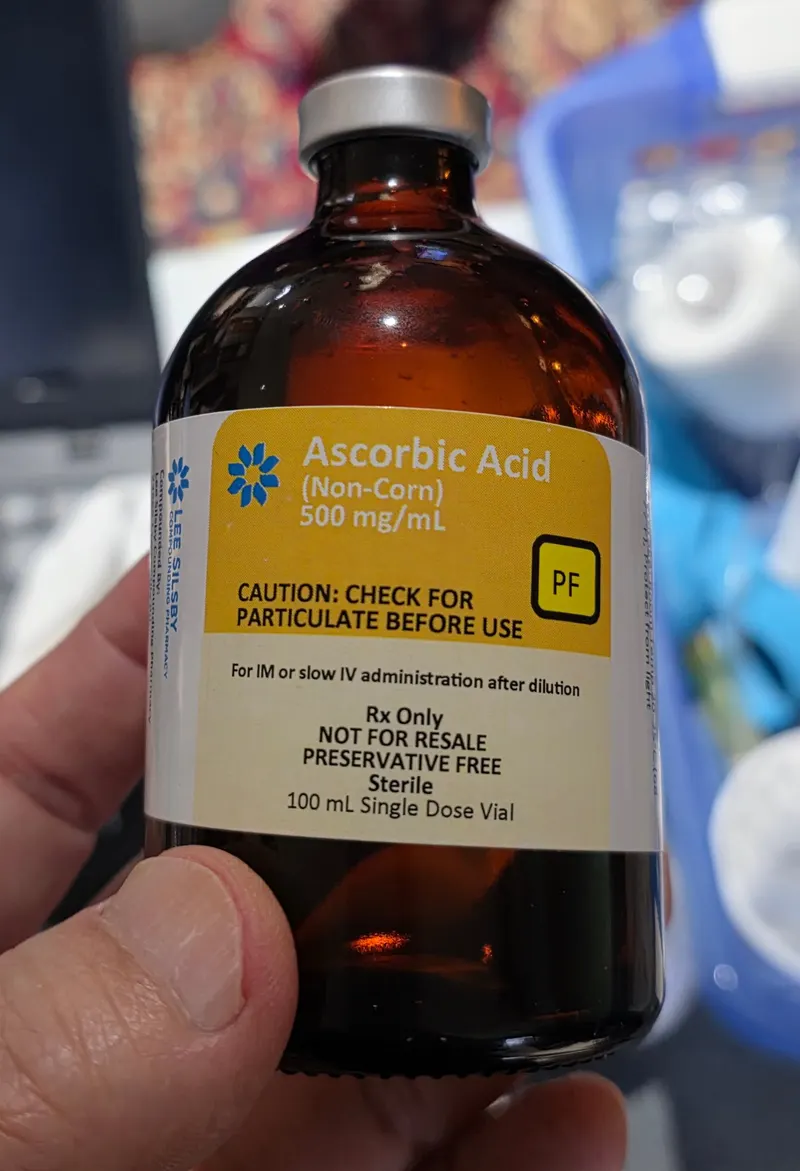
Every dental student learns about scurvy, the vitamin C deficiency that made sailors’ gums swell, bleed, and let go of their teeth. Most people treat it as a history lesson. I don’t. Milder vitamin C shortfalls are still common, and the gums are often the first place they show. Understanding vitamin C for gum health explains why some people’s gums bleed even though they brush well, and why the amount of vitamin C you take matters more than most guidelines suggest.
My approach to vitamin C comes largely from Dr. Wang Jae Lee, a professor at Seoul National University College of Medicine who has spent decades researching vitamin C and is the author of Vitamin C in Human Health and Disease (Springer, 2019). Vitamin C was also a major theme in my integrative training through the American College of Integrative Medicine and Dentistry (ACIMD). In this article I’ll explain what vitamin C does for your gums, why I recommend doses well above the official allowance, the benefits of IV vitamin C, what the research does and doesn’t show, and how to take high doses safely.
Key takeaways
- Vitamin C is essential for collagen, the protein that gives your gums and the ligament around each tooth their strength. Humans can’t make it, so every milligram has to come from food or supplements.
- Research links low vitamin C with gums that bleed easily, and bleeding improves when people who are low take more.
- The official allowance (75 mg a day for women, 90 mg for men) is set to prevent deficiency, not to keep tissues saturated during stress, smoking, inflammation, or healing.
- Following Dr. Lee’s approach, I recommend 1,000 to 2,000 mg right after each meal (total 3,000 to 6,000 mg) a day. I’ve seen many patients’ bleeding gums, mouth ulcers, and gum inflammation clearly improve on this regimen.
- IV vitamin C raises blood levels far beyond what oral doses can reach. I’m happy to explain it during a consultation.
- High doses are safe for most healthy adults when you drink plenty of water, adjust the dose if your stomach complains, and check with your physician first if you have a history of kidney stones, kidney disease, or iron overload.
- Vitamin C works alongside thorough cleaning and periodontal care. It doesn’t replace them.
Vitamin C for Gum Health: Why Your Gums Need It
Your gums are built largely from collagen. So is the periodontal ligament, the fibrous attachment that holds each tooth in its socket, and so are the walls of the tiny blood vessels that run through gum tissue. The enzymes that build stable collagen fibers can’t work without vitamin C. When vitamin C runs short, newly made collagen is weaker, small vessels become fragile and bleed easily, and wounds heal more slowly.
Vitamin C does more than build collagen:
- It’s an antioxidant. It neutralizes the reactive oxygen molecules that immune cells release when they fight bacteria in gum pockets, which limits collateral damage to the surrounding tissue. It also recycles vitamin E back into its active form.
- It supports immune cells. White blood cells concentrate vitamin C at many times the level found in blood, and they use it up quickly during infection.
- It supports healing after deep cleanings, extractions, and implant surgery, all of which depend on new collagen.
Here’s the part that matters most: humans can’t make vitamin C. Most animals produce their own. Humans, along with other primates and a few other species, carry a broken copy of the gene for the last enzyme in that pathway. Dr. Lee’s laboratory research has used mice engineered with the same defect, which become dependent on dietary vitamin C just as we are. For us, every bit of vitamin C has to come from what we eat or take, and our bodies don’t store much of it.
What Happens to Gums When Vitamin C Runs Low
The link between vitamin C and the gums has been recognized for centuries. Ancient descriptions of scurvy, including one attributed to Hippocrates, mention foul breath and loose, bleeding gums. In the 1700s, James Lind showed that citrus fruit cured scurvy in sailors.
Modern research shows that you don’t need full-blown scurvy for your gums to suffer:
- In a controlled depletion study, healthy men who lived in a research unit and ate a diet with only 5 mg of vitamin C a day developed significantly more gum bleeding within about a month. When vitamin C was restored, bleeding returned to baseline.
- A 2021 systematic review and meta-analysis in Nutrition Reviews combined 15 clinical trials from six countries with survey data from more than 8,000 Americans. Gums that bled on gentle probing were associated with low blood levels of vitamin C, and increasing vitamin C intake in people with low levels reversed the tendency. The authors suggested that current intake recommendations may be too low for optimal gum health.
- Low vitamin C is common. National survey data from 2017 to 2018 found that about 6.8% of U.S. adults were deficient, and many more had levels below what’s considered adequate. Smokers and people who eat few fruits and vegetables are at highest risk.
Plaque is still the most common cause of bleeding gums, and no vitamin can remove it. But when a patient’s gums bleed more than their plaque would explain, or keep bleeding after good cleanings, vitamin C is one of the first things I think about (see also what your tongue and mouth reveal about nutrient deficiencies).
Why I Look Beyond the Official Allowance
The Recommended Dietary Allowance for vitamin C is 75 mg a day for adult women and 90 mg for men, plus 35 mg for smokers. Those numbers are designed to prevent deficiency in healthy people. They come largely from careful studies at the National Institutes of Health in the 1990s, in which healthy young volunteers were depleted of vitamin C and then given increasing doses. In those studies, white blood cells were saturated at about 100 mg a day and blood levels were essentially saturated at about 1,000 mg a day, and the researchers concluded that intakes above about 400 mg added little for healthy people.
Dr. Lee’s view, and mine, is that a healthy volunteer resting in a research unit isn’t the person who walks into a dental office with inflamed, bleeding gums. Chronic inflammation, infection, smoking, stress, poor sleep, and surgery all use up vitamin C faster. The body’s ability to keep tissues topped up also depends on how vitamin C is taken:
- Absorption falls as a single dose gets larger. In the NIH studies, almost all of a 200 mg dose was absorbed, while a smaller share of larger single doses was. Dr. Lee cites data showing absorption above 80% for doses under 100 mg and about 62% at 1,250 mg.
- Blood levels drop within hours. Whatever isn’t held in tissues is excreted fairly quickly.
- So timing matters. Rather than one large dose a day, Dr. Lee recommends spreading vitamin C through the day, about three times daily, so the body stays saturated around the clock.
That’s the logic behind dividing a high daily total into doses taken with each meal.
Why People Respond Differently
Not everyone gets the same benefit from the same dose, and I believe two things explain much of that difference. First, vitamin C enters our cells through dedicated carriers called sodium-dependent vitamin C transporters, SVCT1 and SVCT2. People differ in how many of these transporters they have and in how well they work, partly because of common gene variants. So two people taking the same amount can end up with very different levels in their tissues. Second, in my experience vitamin C’s therapeutic effects don’t appear gradually. They show up only once intake exceeds about 90% of what a person’s own biochemistry requires. Below that threshold, a dose can look like it isn’t working. Above it, the improvement can be striking. This is one reason I recommend generous doses rather than the minimum.
Where the Unabsorbed Vitamin C Goes
A common objection to high doses is that the unabsorbed portion is simply wasted. I don’t think it is. Vitamin C that isn’t absorbed in the small intestine travels through the colon, where it meets the gut microbiome. A 2021 pilot study found that vitamin C supplements shifted gut bacterial populations in healthy adults. I believe this is one way high doses help steer the gut toward a healthier microbial balance, and through the gut-brain axis, may support overall well-being. The research here is still early, but it’s part of why I see the excess as doing useful work rather than going to waste (see the oral-gut axis).
Dr. Wang Jae Lee’s Approach to Vitamin C
Dr. Lee is a professor in the Department of Anatomy at Seoul National University College of Medicine and one of Korea’s best-known vitamin C researchers. His lab has published dozens of studies on vitamin C, much of it in mice that, like humans, can’t make their own. His English-language book, Vitamin C in Human Health and Disease: Effects, Mechanisms of Action, and New Guidance on Intake (Springer, 2019), reviews the science of vitamin C system by system: the cardiovascular system, cancer, immunity, colds and flu, the brain, aging, stress, digestion, the liver, the skin, and the eyes, and it offers his guidance on how much to take and how to take it. He has also written that he has taken large amounts of vitamin C himself for more than 30 years.
The core of his guidance is simple:
- Take enough. The minimum needed to prevent scurvy isn’t the amount needed for optimal health, especially under stress or illness.
- Take it repeatedly. Divide the daily amount into three doses so tissues stay saturated through the day.
- Take it right after meals. Taking vitamin C with food is easier on the stomach.
- Keep taking it. The benefits depend on staying saturated over time.
My High-Dose Protocol for Gums and Mouth Ulcers
Here’s what I recommend to adult patients who are in good general health:
- Dose: 1,000 to 2,000 mg of vitamin C right after each meal, three times a day. That’s 3,000 to 6,000 mg a day in total.
- Timing: Always right after eating, never on an empty stomach.
- Water: Drink plenty of water throughout the day.
- Kidney support: I also recommend magnesium and vitamin B6 (more on why below).
- If your stomach complains: Cut each dose in half rather than stopping.
- Form: Swallow tablets or capsules. Don’t hold chewable vitamin C in your mouth, because it’s acidic.
In my practice, I’ve seen many patients with bleeding gums, recurring mouth ulcers, and gum inflammation clearly improve on this regimen. That’s the reason I recommend it.
I always pair it with the rest of good periodontal care. Vitamin C can’t dissolve tartar or clean out a deep gum pocket, so patients with active gum disease still need thorough professional cleaning, and often scaling and root planing, plus daily cleaning between the teeth (see holistic gum disease treatment). I think of vitamin C as what helps the tissue heal once the infection has been cleaned out, and what helps it resist coming back.
Benefits of IV Vitamin C
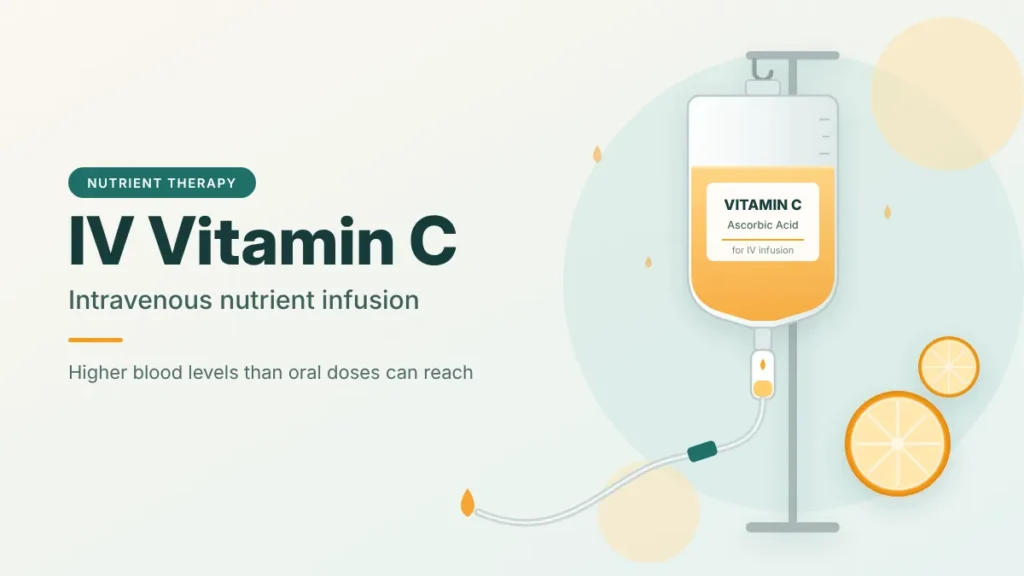
Oral vitamin C has a ceiling. The gut absorbs a smaller share as doses get larger, so blood levels from even the highest oral doses top out. Researchers at the National Institutes of Health found that the same 1.25 g dose produced peak blood levels about six to seven times higher when given intravenously than when taken by mouth. Their models predicted that the largest tolerable oral regimen, 3 g every four hours, would reach about 220 micromoles per liter, while a large IV dose could reach many thousands.
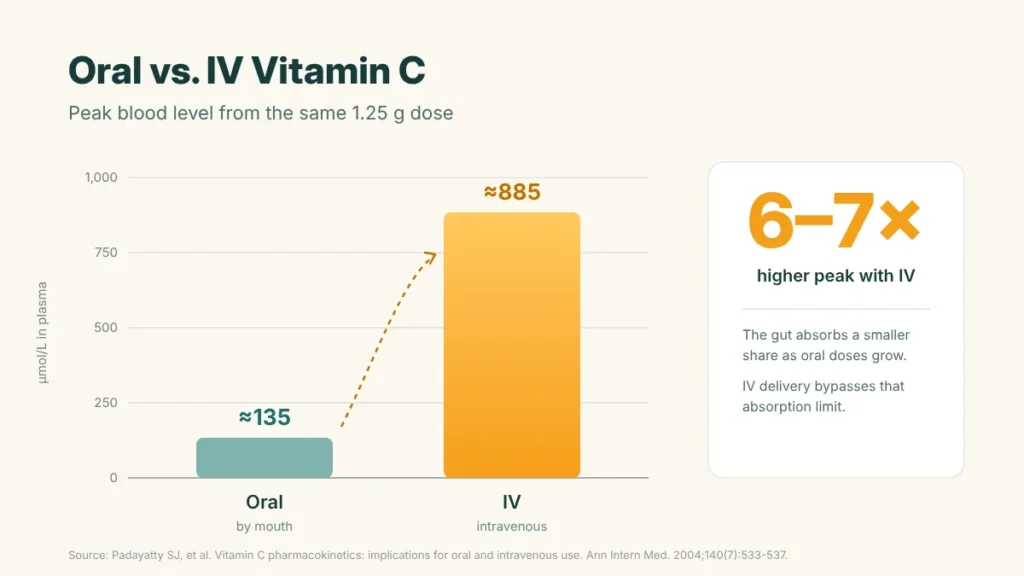
At high oral doses, only a small fraction of each dose is absorbed. In my view, that ceiling is the main limitation of oral vitamin C, and IV delivery overcomes it.
That’s the main benefit of IV vitamin C:
- Much higher blood levels. IV infusions deliver vitamin C straight into the bloodstream, reaching levels no oral dose can.
- No absorption limit. The gut’s transporters, which saturate at higher oral doses, are bypassed entirely.
- No stomach upset. Very high oral doses can cause heartburn or loose stools. IV dosing avoids the digestive tract.
- It works with oral dosing. IV infusions raise levels well beyond what pills can, and the daily oral protocol keeps tissues topped up between infusions.

Research on IV vitamin C specifically for gum disease is limited, so I see it as a way to push vitamin C levels higher, not as a replacement for the oral protocol or for periodontal treatment.
IV vitamin C is a medical procedure, so it requires a careful health history and screening first:
- G6PD deficiency. In people with this inherited condition, high-dose IV vitamin C can cause red blood cells to break down. A simple blood test identifies it before the first infusion.
- Kidney function. Rare cases of oxalate-related kidney injury have been reported after high-dose infusions, mostly in people with reduced kidney function.
- Diabetes. Some fingerstick glucose meters read falsely high for hours after an infusion. If you check your blood sugar, your care team needs to know.
- Heart or kidney failure. Large infusions carry a fluid and sodium load.
A 2020 review of 74 studies of high-dose IV vitamin C found no consistent evidence of more harm than placebo in double-blind trials, while recommending specific monitoring for exactly these issues.
If you’re interested in IV vitamin C, I’m happy to explain how it works, who may benefit, and what screening is involved during a consultation.
What the Research Shows, and What It Doesn’t
I want to be straightforward about the evidence, because you deserve to know where my recommendation comes from.
What’s well established:
- Vitamin C is essential for collagen and for healthy gums.
- Low vitamin C makes gums bleed, and correcting it reduces bleeding.
- Smokers need more.
What clinical studies suggest:
- Gum disease treatment. A 2021 systematic review of six randomized trials found that adding vitamin C supplements to non-surgical periodontal treatment improved bleeding and inflammation in people with gingivitis and in people with diabetes, but didn’t significantly improve pocket depth or attachment in people with periodontitis. These trials were small and short, and most used far lower doses than I recommend.
- Mouth ulcers. In a small 2010 study of 16 children and teenagers with recurrent canker sores, high-dose oral vitamin C (2,000 mg per square meter of body surface a day, roughly comparable to several grams a day for an adult) cut ulcer outbreaks by about half and reduced pain. The authors called their results preliminary.
What hasn’t been studied well: There are no large, long-term randomized trials testing 3,000 to 6,000 mg a day specifically for gum health. That’s a real gap, and it’s why most official guidance stays conservative.
But the absence of a large trial isn’t proof that something doesn’t work. Large, long trials of inexpensive, unpatentable nutrients are hard to fund. In my experience, many clinicians who dismiss high-dose vitamin C have never watched patients take it consistently and seen what happens to their gums. My recommendation rests on the biology, on Dr. Lee’s research and guidance, and on what I’ve seen in my own patients.
How to Take High-Dose Vitamin C Safely
For most healthy adults, high-dose oral vitamin C is well tolerated. Vitamin C is water-soluble, and what the body doesn’t use is excreted in urine. You should still know that the official Tolerable Upper Intake Level for adults is 2,000 mg a day. That limit was set mainly because of stomach upset and loose stools at higher intakes. The doses I recommend are above it, which is exactly why the steps below matter.
Check with your physician first if you have:
- A history of kidney stones or any kidney disease. Vitamin C is partly converted to oxalate, a component of the most common type of kidney stone, and people with reduced kidney function clear it less efficiently.
- Hemochromatosis or another iron-overload condition. Vitamin C increases iron absorption.
- G6PD deficiency, an inherited red-blood-cell condition in which very high doses of vitamin C can trigger problems.
- Pregnancy or breastfeeding.
- A continuous glucose monitor. Some sensors can read falsely high when you take more than about 500 mg of vitamin C a day. Check your device’s instructions and tell your diabetes care team.
- Cancer treatment or other ongoing medical treatment, so your medical team knows everything you take.
Protecting your kidneys
The main concern people raise about high-dose vitamin C is kidney stones. In a large study of Swedish men, regular vitamin C supplement users had about twice the stone risk of non-users, and a U.S. study of men found modestly higher risk at intakes of 1,000 mg a day or more. Studies in women haven’t shown the same link. Here’s how I recommend lowering the risk:
- Drink plenty of water. This has the strongest evidence of any stone-prevention measure. In a five-year randomized trial, people who drank enough to produce at least 2 liters of urine a day had about half as many recurrent stones. Aim for pale yellow urine throughout the day.
- Take Magnesium. Magnesium binds oxalate in the gut and in urine, and men with the highest magnesium intake had about 30% fewer stones in a large U.S. study.
- Take vitamin B6. B6 is needed for the body to process glyoxylate without turning it into oxalate, and it’s used to treat an inherited condition that causes excess oxalate. Population studies haven’t shown that B6 intake alone lowers stone risk, but I include it as part of the kidney-protection routine for patients on high doses. Stay within ordinary supplement amounts. Long-term intake above 100 mg a day can damage nerves.
- Don’t cut out calcium. Calcium-rich foods eaten with meals bind oxalate in the gut. Low-calcium diets actually raise stone risk.
If your stomach complains
High doses can cause heartburn, stomach upset, gas, or loose stools, especially when taken on an empty stomach.
- Always take vitamin C right after a meal.
- If you get heartburn or stomach upset, cut each dose in half. Many people can build back up over time.
- Loose stools mean the dose is more than your gut can absorb right now. Reduce until stools are normal.
- Consider a buffered form, such as sodium ascorbate or calcium ascorbate, which some people find gentler than plain ascorbic acid.
Don’t stop just because it’s uncomfortable
In my experience, the most common reason high-dose vitamin C fails is that people stop taking it the first time it bothers their stomach. The benefit comes from staying saturated over weeks and months. If something doesn’t feel right, adjust the dose rather than quitting.
Protect your enamel
Vitamin C is ascorbic acid. Chewable tablets, powders sipped slowly, and lozenges bathe your teeth in acid and can erode enamel over time. Swallow tablets or capsules with water. If you use a powder, mix it into a drink, finish it quickly, and rinse with plain water afterward.
Food Still Matters
Supplements are how you reach the doses I recommend, but food is still the foundation. Fruits and vegetables bring vitamin C along with fiber, flavonoids, and other nutrients that support healthy gums. Good sources, per typical serving:
| Food | Approximate vitamin C |
|---|---|
| Red bell pepper, ½ cup raw | 95 mg |
| Orange, 1 medium | 70 mg |
| Kiwifruit, 1 medium | 64 mg |
| Broccoli, ½ cup cooked | 51 mg |
| Strawberries, ½ cup | 49 mg |
| Brussels sprouts, ½ cup cooked | 48 mg |
Vitamin C is sensitive to heat and storage, so raw or lightly cooked produce delivers more. Even a very good diet usually supplies a few hundred milligrams a day, which is why reaching gram-level intakes requires supplements.
A Practical Plan
- See your dentist first if your gums bleed. Get a thorough exam and cleaning, and treat any gum disease.
- Review your health history. If you have kidney stones, kidney disease, iron overload, G6PD deficiency, a glucose monitor, or are pregnant, talk with your physician before starting high doses.
- Start vitamin C with meals. 1,000 to 2,000 mg right after breakfast, lunch, and dinner.
- Drink plenty of water and add magnesium and vitamin B6.
- Adjust, don’t quit. Halve the dose if your stomach complains.
- Keep up your home care and professional cleanings, and pay attention to how your gums respond.
- Ask about IV vitamin C during your consultation if you want to raise your levels further. It requires a health history and screening for G6PD deficiency and kidney function first.
- Before surgery, make sure your vitamin C intake is consistent so your tissues are ready to heal (see how to prepare for dental implant surgery).
- If you smoke, quitting will help your gums more than any vitamin.
Frequently Asked Questions
Can vitamin C stop bleeding gums?
It often helps, especially when low vitamin C is part of the cause. Research shows that gum bleeding is associated with low vitamin C and improves when intake increases. In my practice, I’ve seen many patients’ bleeding gums improve on high-dose vitamin C. Plaque is still the most common cause of bleeding, so a dental cleaning and good home care come first.
How much vitamin C should I take for gum health?
The official allowance is 75 mg a day for women and 90 mg for men, plus 35 mg for smokers. Following Dr. Wang Jae Lee’s approach, I recommend 1,000 to 2,000 mg right after each meal, or 3,000 to 6,000 mg a day, for adults in good general health. If you have kidney problems, iron overload, or other medical conditions, check with your physician first.
Is it safe to take 3,000 to 6,000 mg of vitamin C a day?
For most healthy adults, yes, when taken with meals and with plenty of water. These amounts are above the official upper limit of 2,000 mg a day, which was set mainly because of stomach upset. People with a history of kidney stones, kidney disease, hemochromatosis, or G6PD deficiency, and women who are pregnant or breastfeeding, should talk with their physician before taking high doses.
Does high-dose vitamin C cause kidney stones?
Some studies have found a higher risk of kidney stones in men who take vitamin C supplements regularly. To lower the risk, drink plenty of water throughout the day, take magnesium and vitamin B6, and keep calcium-rich foods in your diet. If you’ve had kidney stones before, talk with your physician before taking high doses.
Is IV vitamin C better than oral vitamin C?
IV vitamin C reaches much higher blood levels because it bypasses the gut’s absorption limit. The two work well together: daily oral dosing keeps tissues topped up, and IV infusions raise levels further. IV vitamin C requires a health history and screening for G6PD deficiency and kidney function before the first infusion. I’m happy to explain IV vitamin C during a consultation.
Can vitamin C help with mouth ulcers?
It may. In a small study of children and teenagers with recurrent canker sores, high-dose vitamin C cut outbreaks by about half and reduced pain, and I’ve seen many patients with recurring mouth ulcers improve on high doses. Frequent ulcers can also signal other deficiencies or conditions, so mention them to your dentist or physician.
What if vitamin C upsets my stomach?
Take it right after meals, never on an empty stomach, and cut each dose in half if you get heartburn or stomach upset. Loose stools mean you should reduce the dose until they settle. Buffered forms such as sodium ascorbate are gentler for some people. Adjust the dose rather than stopping completely.
Bottom Line
Your gums depend on vitamin C, your body can’t make it, and many people don’t get enough. Correcting a shortfall reduces bleeding, and in my experience, high doses taken consistently, 1,000 to 2,000 mg after each meal as Dr. Wang Jae Lee recommends, help many patients with bleeding gums, mouth ulcers, and gum inflammation, and IV vitamin C can take levels further than pills can. Take it with meals, drink plenty of water, support your kidneys, adjust the dose instead of quitting, and keep up with the cleaning and periodontal care that only your dental team can provide.
References
- Lee WJ. Vitamin C in Human Health and Disease: Effects, Mechanisms of Action, and New Guidance on Intake. Dordrecht: Springer; 2019.
- Hujoel PP, Kato T, Hujoel IA, Hujoel MLA. Bleeding tendency and ascorbic acid requirements: systematic review and meta-analysis of clinical trials. Nutrition Reviews. 2021. Summary: ScienceDaily.
- Leggott PJ, et al. Effects of ascorbic acid depletion and supplementation on periodontal health and subgingival microflora in humans. Journal of Dental Research. 1991;70(12):1531-1536.
- Levine M, et al. Vitamin C pharmacokinetics in healthy volunteers: evidence for a recommended dietary allowance. Proceedings of the National Academy of Sciences USA. 1996;93(8):3704-3709.
- Fageeh HN, et al. Efficacy of vitamin C supplementation as an adjunct in the non-surgical management of periodontitis: a systematic review. Systematic Reviews. 2021;10:5.
- Yasui K, et al. The effect of ascorbate on minor recurrent aphthous stomatitis. Acta Paediatrica. 2010;99(3):442-445.
- Powers CD, et al. Vitamin C status of US adults assessed as part of the National Health and Nutrition Examination Survey remained unchanged between 2003–2006 and 2017–2018. Journal of Applied Laboratory Medicine. 2023;8(2):272-284.
- National Institutes of Health, Office of Dietary Supplements. Vitamin C fact sheet for health professionals.
- Thomas LDK, et al. Ascorbic acid supplements and kidney stone incidence among men: a prospective study. JAMA Internal Medicine. 2013;173(5):386-388.
- Taylor EN, Stampfer MJ, Curhan GC. Dietary factors and the risk of incident kidney stones in men: new insights after 14 years of follow-up. Journal of the American Society of Nephrology. 2004;15(12):3225-3232.
- Borghi L, et al. Urinary volume, water and recurrences in idiopathic calcium nephrolithiasis: a 5-year randomized prospective study. Journal of Urology. 1996;155(3):839-843.
- Ferraro PM, et al. Vitamin B6 intake and the risk of incident kidney stones. Urolithiasis. 2018;46(3):265-270.
- Padayatty SJ, et al. Vitamin C pharmacokinetics: implications for oral and intravenous use. Annals of Internal Medicine. 2004;140(7):533-537.
- Yanase F, et al. Harm of IV high-dose vitamin C therapy in adult patients: a scoping review. Critical Care Medicine. 2020;48(7):e620-e628.
- Otten AT, et al. Vitamin C supplementation in healthy individuals leads to shifts of bacterial populations in the gut: a pilot study. Antioxidants. 2021;10(8):1278.
About the Author

Dr. Gyu Hwang, DDS, practices at Evergreen Dental Wellness in Annandale, Virginia. He has treated patients since 2004, beginning with his clinical training at the University of Michigan School of Dentistry (DDS, 2006). His postgraduate training includes the Pankey Institute, the Dawson Academy, the Kois Center, and biological and integrative dentistry through the American College of Integrative Medicine and Dentistry (ACIMD). His practice focuses on biological dentistry, implants, laser dentistry, and sleep appliances. Read more about Dr. Hwang.
This article is for education and does not replace advice from your dentist or physician. Talk with your physician before starting high-dose supplements if you have a medical condition or take prescription medications.