
Ask a room of biological dentists which tool they would least like to give up, and many will say ozone. Ask a room of conventional dentists, and many will roll their eyes. Both reactions have some basis. Ozone therapy in dentistry is a genuinely useful antimicrobial adjunct in certain situations, and it is also one of the most over-promised treatments in the holistic world.
Oxygen/ozone therapy was a core topic in my postgraduate training through the American College of Integrative Medicine and Dentistry (ACIMD), where it is taught as part of a “biological standard of care.” In this article I’ll explain what ozone is, how dentists use it, what the research actually supports, and the safety questions you should ask before anyone uses it in your mouth.
Key takeaways
- Ozone (O₃) is a powerful oxidizer that kills bacteria, fungi, and viruses on contact. In dentistry it is used as gas, ozonated water, or ozonated oil.
- The best evidence is for ozone as an add-on to standard gum treatment and for short-term comfort after some procedures. It does not replace cleaning, disinfection, or surgery.
- Claims that ozone reliably “reverses cavities” or “sterilizes” root canals are not supported by strong evidence.
- Ozone gas is harmful to the lungs. A responsible office uses sealed delivery systems and high-volume suction.
What Is Dental Ozone?
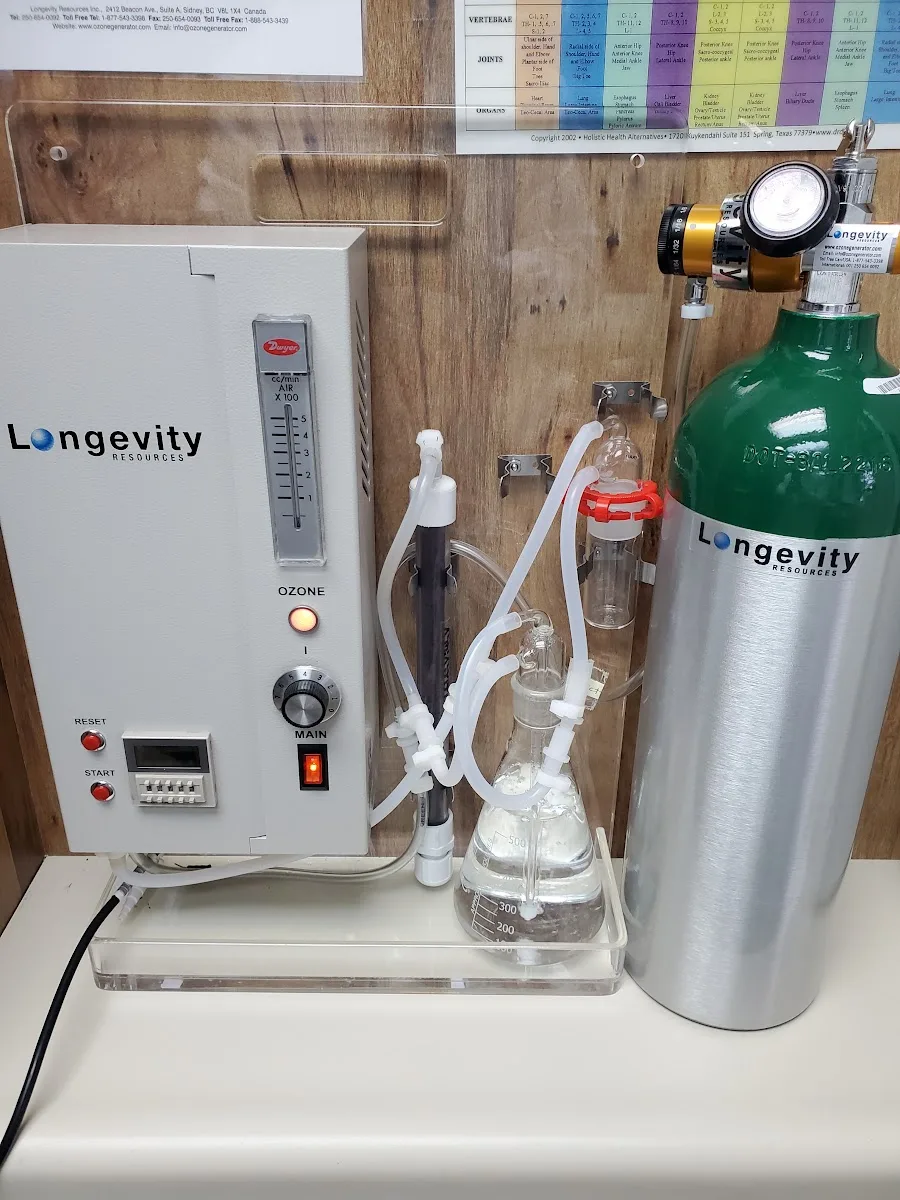
Ozone is a molecule made of three oxygen atoms. In the upper atmosphere it shields us from ultraviolet light; at ground level it is a lung irritant. In a dental office, a medical ozone generator passes pure medical-grade oxygen through an electrical field, converting a small, controlled fraction of it into ozone. The dentist then delivers it in one of three forms:

- Ozone gas, applied through a sealed cup or a fine cannula into a gum pocket, root canal, or extraction site
- Ozonated water, used as a rinse or irrigant
- Ozonated oil (usually olive oil), applied to sores or surgical sites, where it releases its oxidizing activity slowly
Because ozone breaks down quickly, the water and gas forms have to be made fresh, right at the chair.
How Ozone Works
Ozone kills microbes by oxidizing their cell membranes. Bacteria have relatively weak antioxidant defenses at the cell surface, so a brief exposure can rupture them. That is the well-established part.
Proponents also describe a second effect: low, repeated doses of ozone create a mild oxidative “signal” that may increase local blood flow and trigger the body’s own antioxidant enzymes. This idea comes mostly from laboratory and animal research. It is plausible, but it has not been proven to change outcomes in dental patients, and I’d treat it as a hypothesis rather than a fact.
How Dentists Use Ozone
In a biological practice you are most likely to see ozone used in these ways:

- Gum (periodontal) treatment: irrigating or insufflating pockets before and after scaling and root planing
- Root canal treatment: as an extra disinfection step after the canals have been cleaned and shaped
- Extractions and implant surgery: rinsing the site and applying ozonated oil afterward to support soft-tissue healing
- Early cavities and sensitive teeth: applying gas to small lesions or exposed root surfaces
- Mouth sores: canker sores, cold sores, and denture irritation
What the Research Actually Shows
This is where honesty matters. Here is my summary of the clinical evidence as it stands today:
| Use | What studies show | Strength of evidence |
|---|---|---|
| Gum disease (with scaling and root planing) | Several small trials show modestly better short-term pocket and bleeding improvements when ozone is added to cleaning; others show no difference | Low to moderate; mixed |
| Healing after oral surgery or implants | Some trials report less discomfort and better soft-tissue healing in the first days | Low; benefits are short-term |
| Root canal treatment | Ozone may reduce post-treatment pain; lab studies disagree on whether it disinfects as well as standard sodium hypochlorite | Low; adjunct only |
| Reversing cavities | Early enthusiasm was not confirmed by systematic reviews | Very low |
| Before bonding a filling | Ozone may weaken the bond between filling and tooth | Caution |
A 2025 systematic review of 11 randomized trials concluded that ozone shows promise as an adjunct for periodontal health, post-surgical healing, and post-endodontic pain, but the authors noted short follow-up, inconsistent protocols, and benefits that sometimes faded over time. They also advised against routine use in restorative dentistry because of possible effects on bond strength.
For cavities, the picture is weaker. An early Cochrane review found no reliable evidence that applying ozone gas stops or reverses tooth decay, and a UK health technology assessment reached a similar conclusion about the HealOzone device. That doesn’t mean ozone is useless around early lesions, but it does mean that “ozone instead of a filling” should not be presented as a proven option.
For root canals, a frequently cited 2004 study found that ozonated water killed bacteria in dentin tubules about as well as 2.5% sodium hypochlorite in the lab. A 2005 study using bacterial biofilms found ozone less effective than hypochlorite. My reading: ozone can be a reasonable extra step, but it should never replace thorough mechanical cleaning and proven irrigants.
Safety: The Part Many Websites Skip
Ozone’s strength is also its risk. Inhaled ozone damages lung tissue, and in the United States the FDA’s general labeling regulation states bluntly that ozone “is a toxic gas with no known useful medical application in specific, adjunctive, or preventive therapy.” That regulation was written to limit ozone in the air we breathe, and dental ozone therapy remains outside the mainstream standard of care in the U.S. Neither fact proves dental ozone is harmful when used carefully, but both are good reasons to insist on strict technique.
In practice, that means:
- Medical-grade oxygen as the source gas. Generators that make ozone from room air also produce nitrogen oxides.
- Sealed delivery (cups, cannulas, closed syringes), never ozone gas blowing loosely around the mouth.
- High-volume suction at the treatment site to capture any escaping gas.
- Known concentrations and times, documented in your chart.
- No gas near the airway. Brief coughing is the most common side effect when technique slips.
Be wary of any provider who says ozone has “no side effects,” that it can “sterilize” a tooth, or that it can substitute for gum treatment, a root canal, or an extraction that you actually need.
How I Think About Ozone
In my view, ozone belongs in the same category as lasers and antimicrobial rinses: a disinfection aid that can make good dentistry a little better. It cannot make inadequate dentistry adequate. The foundation is still diagnosis, thorough mechanical removal of biofilm and infected tissue, and a healing environment, which means blood sugar control, not smoking, good nutrition, and consistent home care.
If you are considering a practice that offers ozone, the right question isn’t “Do you use ozone?” It’s “What is the ozone adding to the treatment you’re recommending, and what does the evidence say about it?”
Questions to ask before ozone treatment
- What problem is the ozone meant to solve, and what is the standard treatment it is being added to?
- What form (gas, water, or oil) and concentration will you use?
- How do you keep ozone gas away from my airway?
- Is there an added fee, and what happens if I decline it?
If you’d like to understand how ozone fits alongside other tools, see my guides to holistic laser dentistry and what a biological dentist does differently.
Frequently Asked Questions
Is ozone therapy safe for teeth and gums?
When it is delivered with medical-grade oxygen, sealed applicators, and strong suction, dental ozone appears to have a good short-term safety record in clinical studies. The main risk is breathing in ozone gas, which irritates the lungs. Ask how your dentist keeps the gas away from your airway.
Can ozone reverse a cavity?
Not reliably. Early studies were promising, but systematic reviews have not found strong evidence that ozone stops or reverses decay. For very early lesions, proven measures like diet change, remineralizing toothpaste, and sealants are more dependable, and established cavities still need to be cleaned and restored.
Does ozone replace a root canal or gum treatment?
No. Ozone is an add-on. In root canals it is used after the canals are cleaned, and in gum treatment it is combined with scaling and root planing. Used alone, it cannot remove calculus, infected tissue, or a dead nerve.
Is dental ozone FDA-approved?
Ozone therapy is not part of the mainstream U.S. dental standard of care, and the FDA’s general regulation describes ozone as a toxic gas with no known useful medical application. Dentists who use it are applying it as an adjunct based on their own judgment and training, which is why you should ask about the evidence and safety steps.
Bottom Line
Ozone is a fast-acting antimicrobial that can modestly improve some gum and surgical outcomes when it is added to proper treatment. It is not a cure-all, it does not reliably reverse cavities, and it must be used with care because the gas itself is harmful to breathe. A good biological dentist will be able to tell you exactly what ozone adds to your care and why.
References
- Rezaeianjam M, et al. Efficacy of ozone therapy in dentistry with approach of healing, pain management, and therapeutic outcomes: a systematic review of clinical trials. BMC Oral Health. 2025;25:433.
- Rickard GD, et al. Ozone therapy for the treatment of dental caries. Cochrane Database of Systematic Reviews. 2004;(3):CD004153.
- Brazzelli M, et al. Systematic review of the effectiveness and cost-effectiveness of HealOzone for the treatment of occlusal pit/fissure caries and root caries. Health Technology Assessment. 2006;10(16).
- Nagayoshi M, et al. Antimicrobial effect of ozonated water on bacteria invading dentinal tubules. Journal of Endodontics. 2004;30(11):778-781.
- Hems RS, et al. An in vitro evaluation of the ability of ozone to kill a strain of Enterococcus faecalis. International Endodontic Journal. 2005;38(1):22-29.
- U.S. Food and Drug Administration. 21 CFR 801.415 — Maximum acceptable level of ozone.
About the Author

Dr. Gyu Hwang, DDS, practices at Evergreen Dental Wellness in Annandale, Virginia. He has treated patients since 2004, beginning with his clinical training at the University of Michigan School of Dentistry (DDS, 2006). His postgraduate training includes the Pankey Institute, the Dawson Academy, the Kois Center, and biological and integrative dentistry through the American College of Integrative Medicine and Dentistry (ACIMD). His practice focuses on biological dentistry, implants, laser dentistry, and sleep appliances. Read more about Dr. Hwang.
This article is for education and does not replace an in-person dental evaluation.