
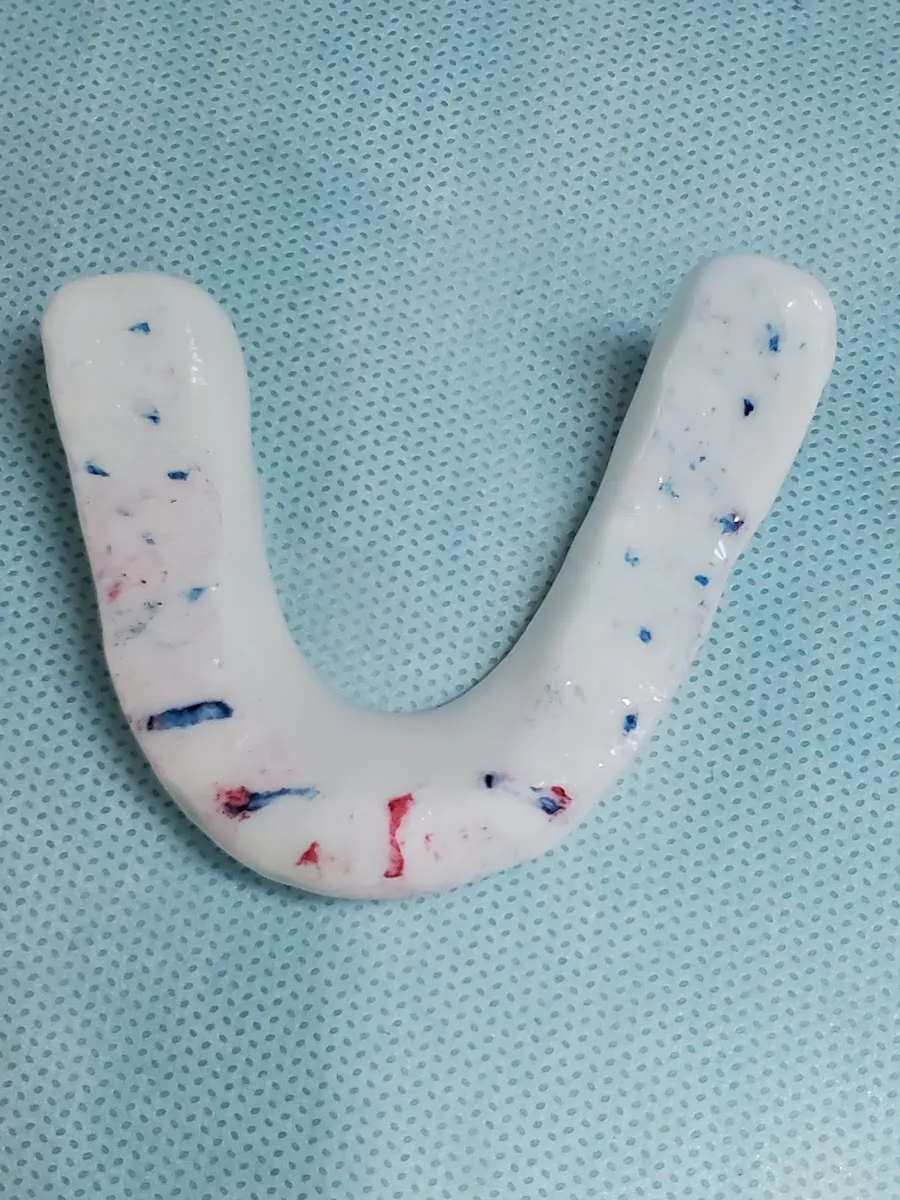
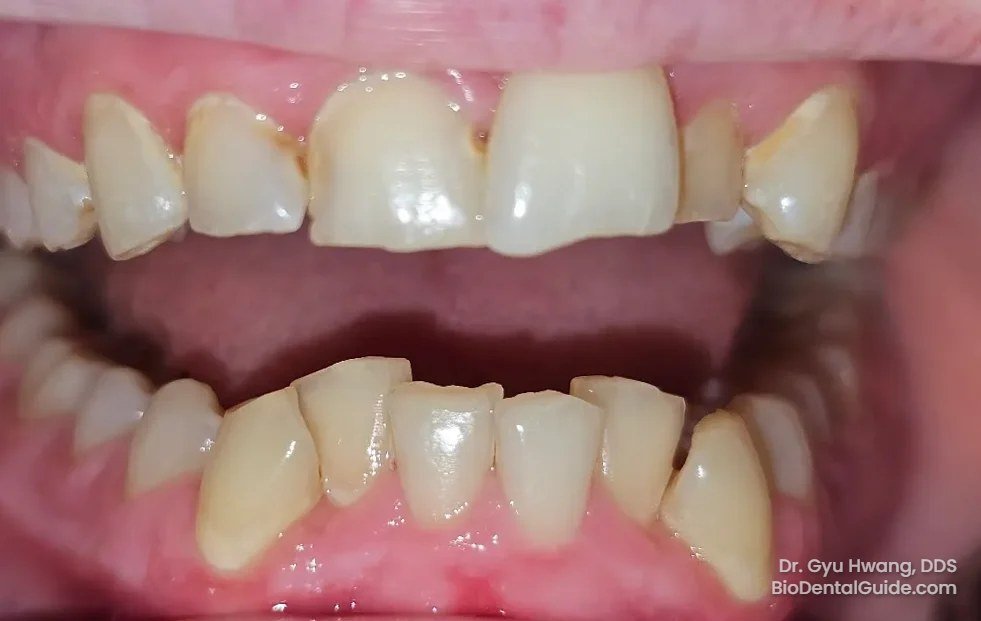
Jaw pain is one of the most confusing symptoms patients bring to a dentist. It can come from the chewing muscles, the jaw joint, a cracked tooth, an inflamed sinus, a nerve, or occasionally the heart. Getting the source right matters, because the treatments are completely different. Understanding the most common jaw pain causes is the first step to finding relief.
Orofacial pain was a dedicated topic in my integrative training through the American College of Integrative Medicine and Dentistry (ACIMD), and the jaw joint and bite were central to my earlier training at the Pankey Institute, the Dawson Academy, and the Kois Center. Here’s the framework I use.
Key takeaways
- Temporomandibular disorders (TMD) affect an estimated 5% to 12% of people and are the most common cause of chronic jaw pain that isn’t from a tooth.
- Muscle pain is usually a dull ache worsened by chewing or clenching. Joint pain is centered in front of the ear, often with clicking or locking. Nerve pain tends to be electric, shooting, or burning.
- Most TMD improves with conservative, reversible care: self-care, physical therapy, stress and sleep management, and sometimes an oral appliance.
- Jaw pain with chest pressure, shortness of breath, or exertion needs emergency care. New jaw pain with chewing plus headache in someone over 50 also needs urgent evaluation.
- T-Scan and surface EMG measure bite timing and jaw muscle activity. They can guide appliance and bite adjustments, but neither one diagnoses TMD on its own.
Jaw Pain Causes: The Main Sources
Muscles (myofascial pain)
The most common type of TMD involves the chewing muscles. It feels like a dull, aching, tired sensation in the cheeks, temples, or jaw angle, often worse in the morning (after nighttime clenching) or late in the day (after chewing or stress). Pressing on the muscles reproduces the pain, and sometimes refers pain to the teeth, ear, or temple.
The jaw joint (TMJ)
The temporomandibular joint sits just in front of the ear. Joint problems can cause pain in that spot, clicking or popping, a feeling of the jaw catching, or difficulty opening fully. A click without pain is common and often needs no treatment. Locking, a jaw that suddenly won’t open fully or won’t close, deserves prompt evaluation.
Teeth and gums
A cracked tooth, deep cavity, or abscess can cause pain that radiates into the jaw and ear. Clues include sensitivity to cold or sweets, pain when biting on a particular tooth, or swelling of the gum. A careful dental exam with X-rays should come early in any jaw pain evaluation.

Nerves (neuropathic pain)
Nerve pain feels different: sharp, electric, shooting, or burning, sometimes triggered by light touch, talking, or a breeze. Trigeminal neuralgia causes brief, severe, shock-like attacks. Persistent pain after a dental procedure, with burning or numbness, can be a nerve injury. Burning in a normal-looking mouth may be burning mouth syndrome (see burning mouth syndrome). Nerve pain usually doesn’t respond to the treatments that help muscle pain, which is why the distinction matters.
Referred pain from elsewhere
The sinuses, ears, neck, and salivary glands can all refer pain to the jaw. So can the heart.
Muscle, Joint, or Nerve? Quick Comparison
| Feature | Muscle | Joint | Nerve |
|---|---|---|---|
| Quality | Dull, aching, tired | Sharp or aching at the joint | Electric, shooting, burning |
| Location | Cheeks, temples, jaw angle | Just in front of the ear | Along a nerve path; may be very localized |
| Triggers | Chewing, clenching, stress | Opening wide, chewing hard foods | Light touch, talking, cold air; sometimes spontaneous |
| Sounds or locking | Usually none | Clicking, popping, catching, locking | None |
| What usually helps | Rest, heat, stretching, physical therapy, appliance | Rest, anti-inflammatories, physical therapy, appliance | Nerve-specific medications; specialist care |
Warning Signs That Need Urgent Attention
Call 911 or go to an emergency department for jaw pain with chest pressure, shortness of breath, sweating, nausea, or pain that comes on with exertion. Heart pain can show up in the jaw, especially in women and people with diabetes.
See a physician promptly for:
- New jaw pain with chewing plus headache, scalp tenderness, or vision changes in someone over 50, which can signal giant cell arteritis
- Fever, facial swelling, or swelling under the jaw
- Numbness of the lip, chin, or tongue
- Progressive difficulty opening the mouth
- Unexplained weight loss, a lump, or a sore that doesn’t heal
- Ear pain with hearing loss
Sleep, Grinding, and the Airway
Clenching and grinding during sleep (sleep bruxism) is a common driver of morning jaw muscle pain. Bruxism frequently travels with sleep-disordered breathing, including obstructive sleep apnea. If you snore, wake unrefreshed, have morning headaches, or your partner notices pauses in your breathing, it’s worth being screened. Because sleep appliances are part of my practice, I routinely consider the airway when I evaluate jaw pain, since treating a sleep-breathing problem can change the whole picture.
A cone-beam CT (CBCT) scan can add another clue. Airway analysis software measures the volume of the upper airway behind the tongue and soft palate and finds its narrowest cross-section, color-coding the tightest areas in red. A small or narrow airway can help explain snoring or nighttime clenching, and it helps me plan a sleep appliance. CBCT has limits, though. The scan is taken while you are awake and upright, and the airway changes shape when the throat muscles relax during sleep. So CBCT can’t diagnose sleep apnea. That requires a sleep study ordered by a physician.


Sleep also matters for the brain itself. Research beginning in 2012 described the brain’s “glymphatic” system, which clears metabolic waste and works most actively during deep sleep. Some integrative clinicians propose that jaw position and TMJ problems affect this system. That link is still a hypothesis, but protecting the quality of your sleep is good for both pain and brain health.
Measuring the Bite and Jaw Muscles: T-Scan and EMG
A careful history and a hands-on exam of the muscles, joints, and teeth come first. Two digital tools can add detail about how your teeth meet and how your jaw muscles respond: T-Scan and surface EMG. Both are measuring tools, not diagnoses, so it helps to know what each one can and can’t tell you.
What T-Scan measures
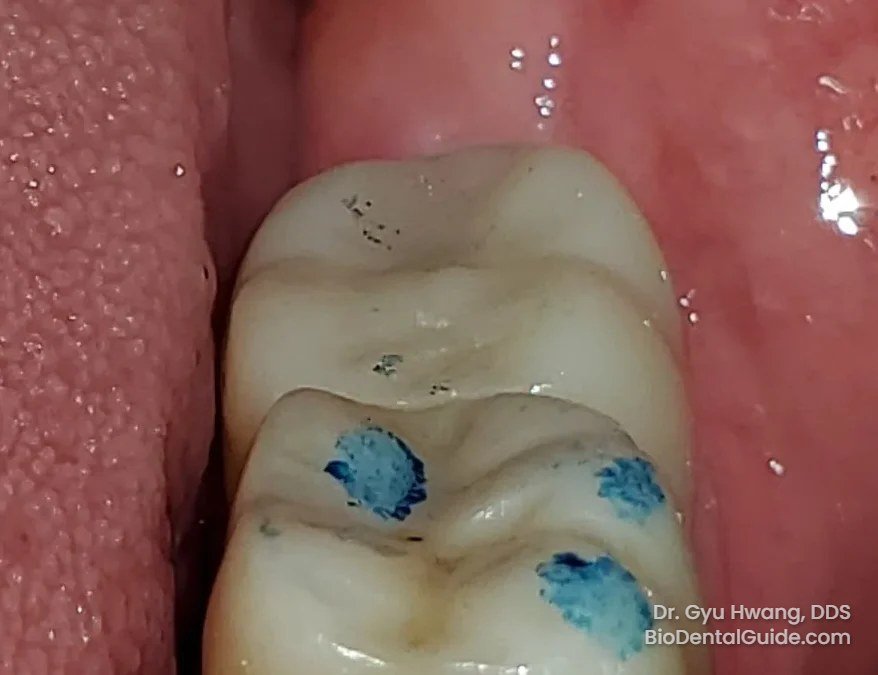
Articulating paper, the colored paper you bite on in the dental chair, shows where your teeth touch. It can’t show which tooth touches first or how hard. T-Scan is a digital bite analysis: you bite on a thin, flexible pressure sensor connected to a computer, which records every contact as a short movie. It shows:
- The order in which teeth make contact, in fractions of a second
- The relative force on each tooth, and the balance between the left and right sides
- How long the back teeth stay in contact when you slide your jaw to the side, a measure called disclusion time
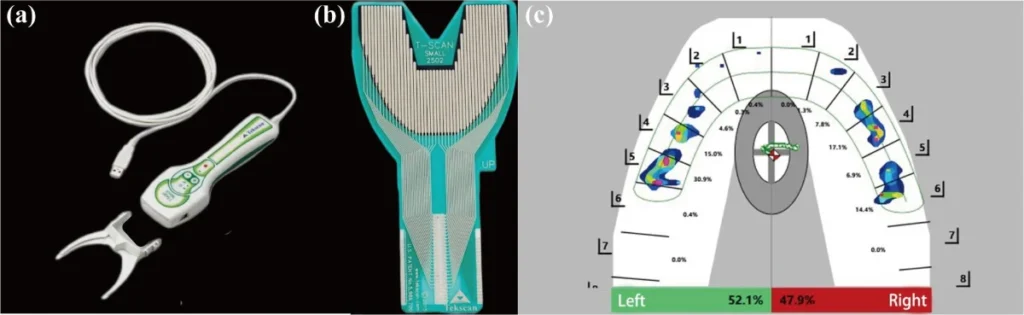
T-Scan is most useful for fine-tuning a night guard or sleep appliance, adjusting a new crown or implant restoration, and checking whether one tooth is carrying an unusual share of the load. It has limits: it measures relative force rather than force in pounds or newtons, and because the sensor sits between the teeth, it can slightly change how they meet. A 2023 laboratory evaluation raised these concerns about the accuracy of its force readings.
What surface EMG measures
Surface electromyography (sEMG) uses small adhesive electrodes on the skin over the temporalis (temple) and masseter (cheek) muscles to record their electrical activity at rest, during a hard clench, and while chewing. It can show whether the muscles relax fully at rest and whether one side works harder than the other. When it is synchronized with T-Scan, it shows how the muscles respond at the moment particular teeth make contact.
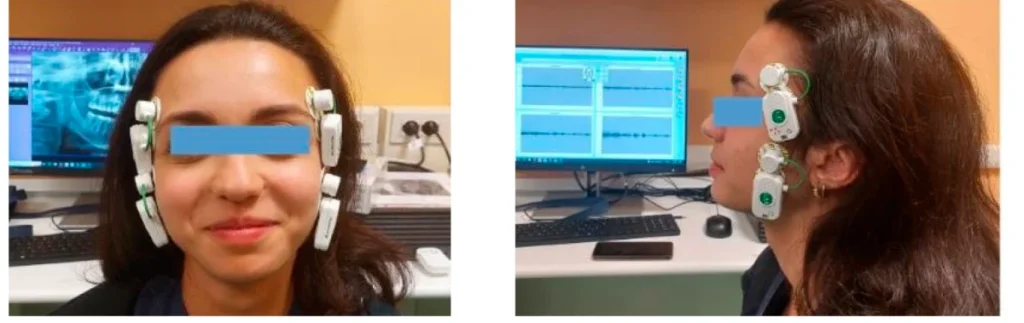
EMG readings vary with electrode position, skin and tissue thickness, and the day of testing. A review in the Journal of the American Dental Association concluded that sEMG does not improve the ability to tell whether someone has TMD beyond a history and clinical exam, and warned that it can lead to unnecessary treatment. I treat EMG as a way to document and track muscle activity, not as a diagnostic test.
Disclusion time reduction: promising but debated
Some dentists use T-Scan and EMG together to guide a bite adjustment called disclusion time reduction (DTR). The dentist selectively reshapes tooth surfaces so the back teeth separate quickly, in under about half a second, when the jaw slides to the side. A 2020 randomized trial in 104 dental students with muscle-related TMD symptoms reported large improvements in symptom scores after DTR compared with a sham polishing. That trial was single-blind, studied a young and narrow group, and some of its authors had financial ties to the companies that make T-Scan and the BioEMG system.
Because reshaping teeth can’t be undone, I put DTR in the same category as other irreversible bite adjustments: something to consider for carefully selected patients after conservative care, not a first step.
Questions to ask before T-Scan or EMG testing
- What will the results change in my treatment plan?
- Will any teeth be reshaped, and is that reversible?
- Will you repeat the measurement to show whether treatment worked?
Treatments That Help
The National Academies of Sciences, Engineering, and Medicine reviewed TMD care in 2020 and called for evidence-based, coordinated approaches, emphasizing that conservative and reversible treatments should come first. In practice, that usually means:

- Self-care: softer foods for a while, avoiding gum and wide yawning, alternating heat and cold, and gentle jaw exercises
- Habit awareness: keeping teeth apart and the jaw relaxed during the day (“lips together, teeth apart”)
- Physical therapy for the jaw and neck, including posture work
- Short-term anti-inflammatory medication when appropriate
- Stress and sleep management, including cognitive behavioral strategies
- An oral appliance (night guard or stabilization splint), which helps some patients and protects teeth from grinding. A well-made, adjusted appliance is very different from a generic boil-and-bite guard.
- Targeted procedures for specific problems, such as injections for muscle trigger points or arthrocentesis (flushing the joint) for certain locking joints
Irreversible treatments such as grinding down the bite, extensive orthodontics, or joint surgery should be reserved for specific diagnoses after conservative care, not offered as a first step for general jaw pain.

You may also encounter neural therapy, injections of local anesthetic into scars, nerves, or trigger points, in integrative settings. It’s part of the integrative curriculum I studied. Injections into muscle trigger points have some support in pain medicine, but broader neural therapy claims haven’t been well tested, so I’d approach them with caution.
If pain persists despite care, an orofacial pain specialist can coordinate a more detailed evaluation. For persistent pain at an old extraction site, see jawbone cavitations.
Frequently Asked Questions
How do I know if my jaw pain is TMJ?
TMJ-related pain is usually felt in front of the ear or in the chewing muscles, worsens with chewing or clenching, and may come with clicking, popping, or limited opening. A dentist or orofacial pain specialist can confirm it with an exam that includes palpating the muscles and joint and checking your teeth to rule out dental causes.
Can a night guard fix TMJ?
A well-designed, properly adjusted oral appliance helps some people, especially those who clench or grind at night, and it protects teeth. It works best as part of a broader plan that includes self-care, habit changes, and sometimes physical therapy, and it isn’t a cure for every type of jaw pain.
Can TMJ cause ear pain, headaches, or neck pain?
Yes. The jaw joint sits right next to the ear canal, and the chewing muscles can refer pain to the temples, ears, and neck. Ear pain with hearing loss, fever, or drainage should still be checked by a physician to rule out ear problems.
When is jaw pain an emergency?
Jaw pain with chest pressure, shortness of breath, sweating, nausea, or pain triggered by exertion can be a heart problem, so call 911. New jaw pain with chewing plus headache or vision changes in someone over 50, facial swelling with fever, or sudden inability to open or close the mouth also need prompt medical attention.
Can sleep apnea cause jaw pain or teeth grinding?
They’re often linked. Sleep bruxism commonly occurs alongside sleep-disordered breathing, and nighttime clenching can cause morning jaw and temple pain. If you snore or wake up tired, ask about a sleep evaluation.
What is a T-Scan at the dentist?
T-Scan is a digital bite analysis. You bite on a thin sensor connected to a computer, which records the order and relative force of your tooth contacts and the balance between the left and right sides. Dentists use it to fine-tune bites, crowns, and oral appliances. It shows how your teeth meet; it doesn’t diagnose TMD by itself.
Can EMG diagnose TMJ problems?
Not on its own. Surface EMG records jaw muscle activity with sensors on the skin, and it can document clenching or uneven muscle activity. Reviews have found that it doesn’t improve TMD diagnosis beyond a careful history and exam, so it is best used to track muscle activity rather than to make the diagnosis.
Can a CBCT scan diagnose sleep apnea?
No. CBCT airway analysis shows the size and narrowest point of your airway while you are awake and upright, which can be a useful screening clue. Sleep apnea is diagnosed with a sleep study, either in a lab or at home, ordered and interpreted by a physician.
Bottom Line
Jaw pain has many possible causes, and naming the right one is half the treatment. Muscle and joint problems usually respond to conservative, reversible care. Nerve pain needs a different approach, dental causes need dental treatment, and certain warning signs need urgent medical care. A careful exam that considers your teeth, joints, muscles, nerves, sleep, and airway is the best path to lasting relief.
References
- National Institute of Dental and Craniofacial Research. Temporomandibular disorders (TMD).
- National Academies of Sciences, Engineering, and Medicine. Temporomandibular Disorders: Priorities for Research and Care. Washington, DC: The National Academies Press; 2020.
- Schiffman E, et al. Diagnostic criteria for temporomandibular disorders (DC/TMD) for clinical and research applications. Journal of Oral & Facial Pain and Headache. 2014;28(1):6-27.
- Iliff JJ, et al. A paravascular pathway facilitates CSF flow through the brain parenchyma and the clearance of interstitial solutes, including amyloid β. Science Translational Medicine. 2012;4(147):147ra111.
- Xie L, et al. Sleep drives metabolite clearance from the adult brain. Science. 2013;342(6156):373-377.
- Wang M, et al. Computerized dynamic occlusal analysis and its correlation with static characters in post-orthodontic patients using the T-Scan system and the ABO objective grading system. BMC Oral Health. 2023;23:312.
- Bawa D, Katona TR. A critical evaluation of the T-Scan digital occlusion analysis system. Indiana University; 2023.
- Klasser GD, Okeson JP. The clinical usefulness of surface electromyography in the diagnosis and treatment of temporomandibular disorders. Journal of the American Dental Association. 2006;137(6):763-771.
- Thumati P, et al. A disclusion time reduction randomized controlled occlusal adjustment trial. Advanced Dental Technologies & Techniques. 2020.
- Nota A, et al. Correlations between mandibular kinematics and electromyography during the masticatory cycle: an observational study by digital analysis. Applied Sciences. 2024;14(21):9996.
- Thereza-Bussolaro C, et al. Some challenges and potential issues regarding cone beam computed tomography of the upper airway. Journal of Dental Sleep Medicine. 2021;8(2).
About the Author

Dr. Gyu Hwang, DDS, practices at Evergreen Dental Wellness in Annandale, Virginia. He has treated patients since 2004, beginning with his clinical training at the University of Michigan School of Dentistry (DDS, 2006). His postgraduate training includes the Pankey Institute, the Dawson Academy, the Kois Center, and biological and integrative dentistry through the American College of Integrative Medicine and Dentistry (ACIMD). His practice focuses on biological dentistry, implants, laser dentistry, and sleep appliances. Read more about Dr. Hwang.
This article is for education and does not replace evaluation by your dentist or physician. If you think you may be having a heart attack, call 911.